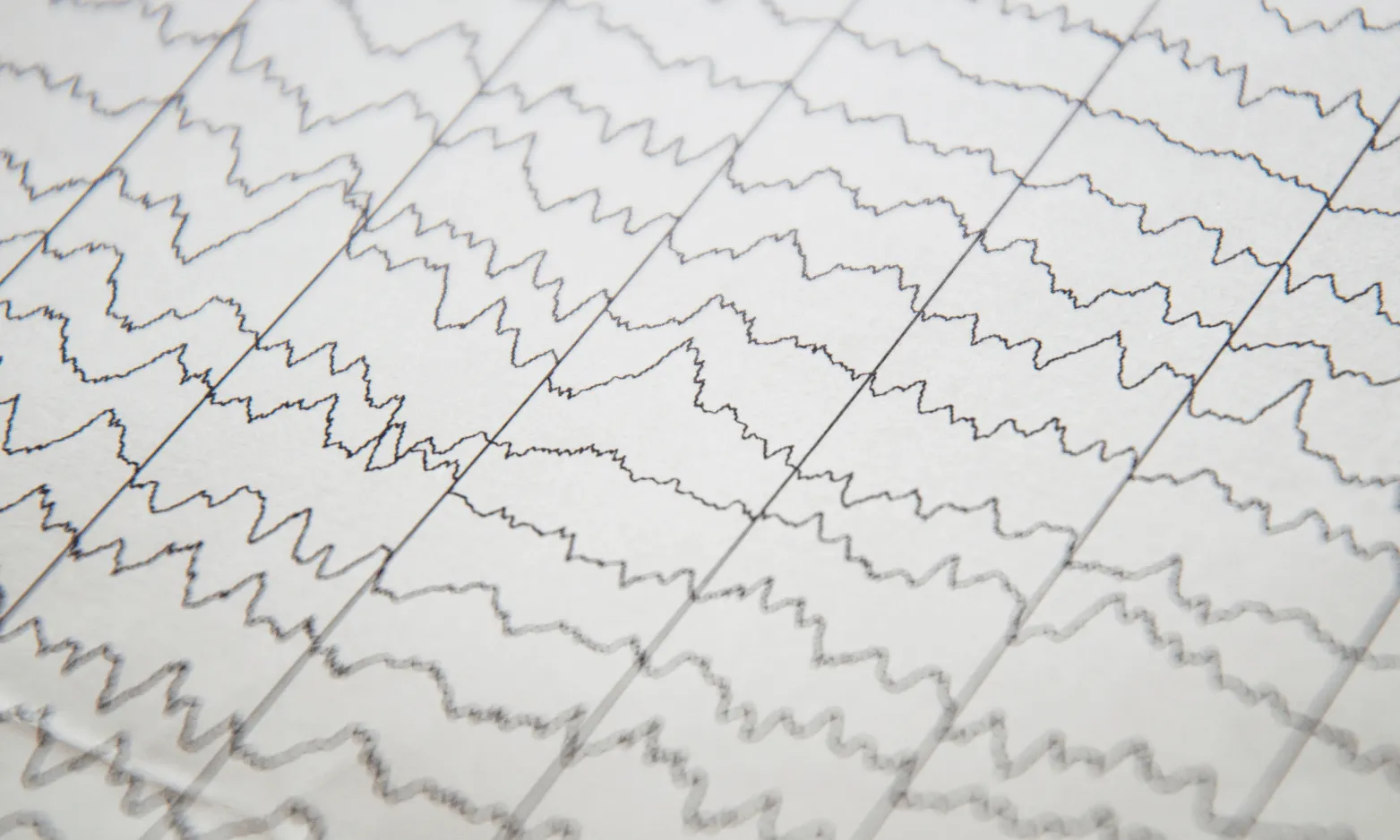
DeepPsy brings replicated EEG and ECG biomarker evidence into one physician-facing report, helping clinicians compare treatment options within an appropriate line of care.8
Treatment response varies substantially between patients
Physiological data can add another dimension to the information already used by the treating physician.
Across independent cohorts, selected EEG and ECG biomarkers have shown treatment-specific associations with response to antidepressants, rTMS, and ketamine-based treatments. When these findings are used to compare suitable options, they provide a basis for identifying treatments with a higher expected likelihood of response.123
Clinical role
The evidence supports choices within an appropriate line of care. It does not diagnose depression, determine the indicated line of treatment, or replace clinician judgement.
For patients
In a retrospective real-world evaluation, report-concordant treatment was associated with a statistically higher response rate (46% versus 26%).8 When reviewed together, the report gives patients a more objective view of their physiology and a clearer basis for discussing the next treatment decision with their clinician.
The evidence becomes specific at the level of each biomarker
Each marker captures a different aspect of brain or autonomic activity. Its relevance depends on the treatment and patient population in which the association was studied. The linked references make that context available without interrupting the narrative.
psychologyResting-state EEG
Vigilance regulation
Characterises how wakefulness and alertness states change during a resting-state EEG recording. Studied in antidepressant treatment and replicated in an independent pharmacotherapy cohort, with additional validation in prolonged-release ketamine.123
Alpha peak frequency (APF)
Measures the dominant frequency within the individual alpha rhythm during rest. Studied in relation to clinical outcome with repetitive transcranial magnetic stimulation (rTMS); reported associations were specific to stimulation parameters.5
Frontal alpha asymmetry (FAA)
Compares frontal alpha activity between hemispheres in the resting-state recording. Studied as a sex-specific predictor in the randomised iSPOT-D antidepressant trial.4
favoriteResting-state ECG
Heart-rate dynamics (BPM)
Captures cardiac rate patterns present during the resting recording. Studied in relation to response during ketamine treatment for major depression.6
Heart-rate variability (HRV)
Describes beat-to-beat variation as a marker of autonomic regulation. Studied in generalized anxiety disorder as a marker of differential response to fluoxetine and mindfulness-based treatment.7
From measured signals to treatment-specific context
DeepPsy integrates all supported biomarkers into one report. For each published correlation, the direction and effect size of the study contribute to its weight, alongside evidence quality and replication. The combined contributions produce treatment-specific likelihood categories for clinical interpretation.8
01
EEG and ECG measurements
Quality-reviewed resting-state biomarker values from the patient’s recording.
→
02
Direction and effect size
Each qualifying study defines how strongly a marker relates to response under a supported treatment.
→
03
Cross-marker integration
Weighted positive, negative, or neutral contributions are combined for each treatment.
→
04
One clinical report
Treatment-specific likelihood categories and narrative interpretation for physician review. View report
A real-world evaluation using the DeepPsy system
After the individual biomarkers were integrated into one report, a retrospective study examined whether report-concordant treatment was associated with higher response in routine specialist care.
153 adults
Zürich
2022 to 2024
Preprint
Higher response was observed when treatment aligned with the report
In the pooled comparison, 42 of 92 patients receiving report-concordant treatment responded, compared with 14 of 54 patients receiving non-concordant treatment. The evaluated modalities were ECT, rTMS, (es)ketamine, and SSRIs.
Response rates following the DeepPsy report in real-world data
Treatment
Not aligned
Not aligned sample
Treatment as usual
Treatment as usual sample
Aligned
Aligned sample
Relative increase
Pooled
26%
54
38%
146
46%
92
+76%
ECT
50%
20
62%
50
70%
30
+40%
1 Hz rTMS
13%
15
25%
48
30%
33
+127%
Es-/ketamine
10%
10
25%
36
31%
26
+208%
SSRI
11%
9
33%
12
100%
3
+800%
Brackets show the relative increase from not aligned to aligned treatment.
Study design
Retrospective and observational, using routinely collected outcomes rather than a prespecified randomised protocol.
Statistical context
The pooled odds ratio was 2.40 with a 95% confidence interval of 1.15 to 5.00. Individual treatment subgroups were small.
Evidence status
The manuscript is a preprint and has not been certified by peer review. The result is an association, not proof of causality.
What the evidence supports today
Current support
Replicated studies provide treatment-specific backing for individual biomarkers. The real-world evaluation adds initial product-level evidence that choices aligned with the integrated DeepPsy report are associated with higher response.
Next evidence required
Prospective, adequately powered trials are required to estimate causal benefit, standardize outcome measurement, assess treatment-specific performance, and clarify which patient groups benefit most.
Source notes
References sit behind the clinical narrative. Each number supports a nearby statement and links to the original publication. This is a curated evidence trail, not an exhaustive paper catalogue.
1
Ip et al. NeuroPharm study: EEG wakefulness regulation as a biomarker in MDD. Journal of Psychiatric Research, 2021.
Ip et al. Pretreatment qEEG biomarkers for predicting pharmacological treatment outcome in major depressive disorder: independent validation from the NeuroPharm study. European Neuropsychopharmacology, 2021.
Monn et al. EEG vigilance and response to oral prolonged-release ketamine in treatment-resistant depression: a double-blind randomized validation study. Psychiatry Research: Neuroimaging, 2025.
Arns et al. EEG alpha asymmetry as a gender-specific predictor of outcome to acute treatment with different antidepressant medications in the randomized iSPOT-D study. Clinical Neurophysiology, 2016.
Corlier et al. The relationship between individual alpha peak frequency and clinical outcome with repetitive Transcranial Magnetic Stimulation (rTMS) treatment of Major Depressive Disorder (MDD). Brain Stimulation, 2019.
Ferreira-Garcia et al. Heart rate variability: a biomarker of selective response to mindfulness-based treatment versus fluoxetine in generalized anxiety disorder. Journal of Affective Disorders, 2021.